Abstract
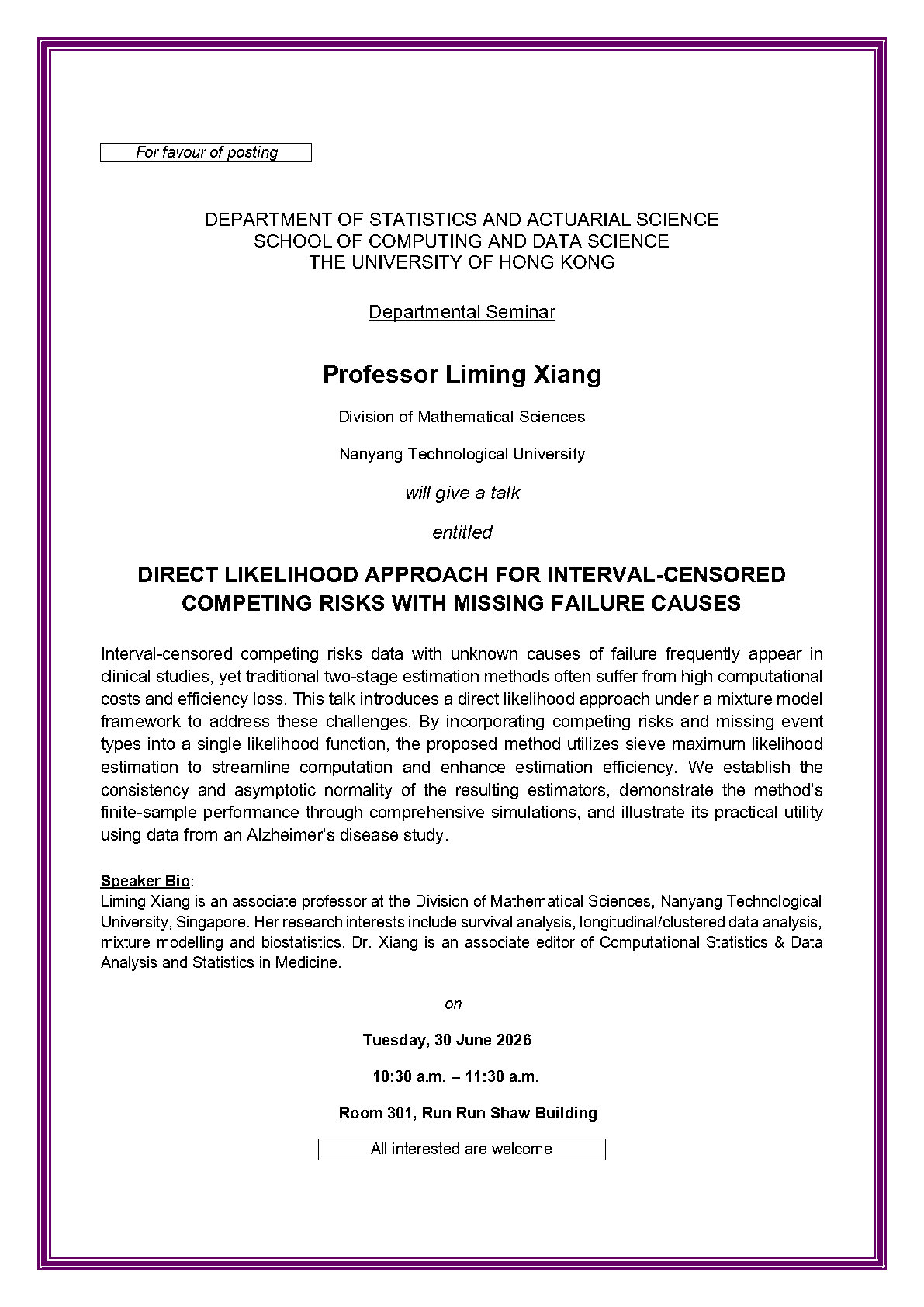
Interval-censored competing risks data with unknown causes of failure frequently appear in clinical studies, yet traditional two-stage estimation methods often suffer from high computational costs and efficiency loss. This talk introduces a direct likelihood approach under a mixture model framework to address these challenges. By incorporating competing risks and missing event types into a single likelihood function, the proposed method utilizes sieve maximum likelihood estimation to streamline computation and enhance estimation efficiency. We establish the consistency and asymptotic normality of the resulting estimators, demonstrate the method’s finite-sample performance through comprehensive simulations, and illustrate its practical utility using data from an Alzheimer’s disease study.
About the speaker
Interval-censored competing risks data with unknown causes of failure frequently appear in clinical studies, yet traditional two-stage estimation methods often suffer from high computational costs and efficiency loss. This talk introduces a direct likelihood approach under a mixture model framework to address these challenges. By incorporating competing risks and missing event types into a single likelihood function, the proposed method utilizes sieve maximum likelihood estimation to streamline computation and enhance estimation efficiency. We establish the consistency and asymptotic normality of the resulting estimators, demonstrate the method’s finite-sample performance through comprehensive simulations, and illustrate its practical utility using data from an Alzheimer’s disease study.